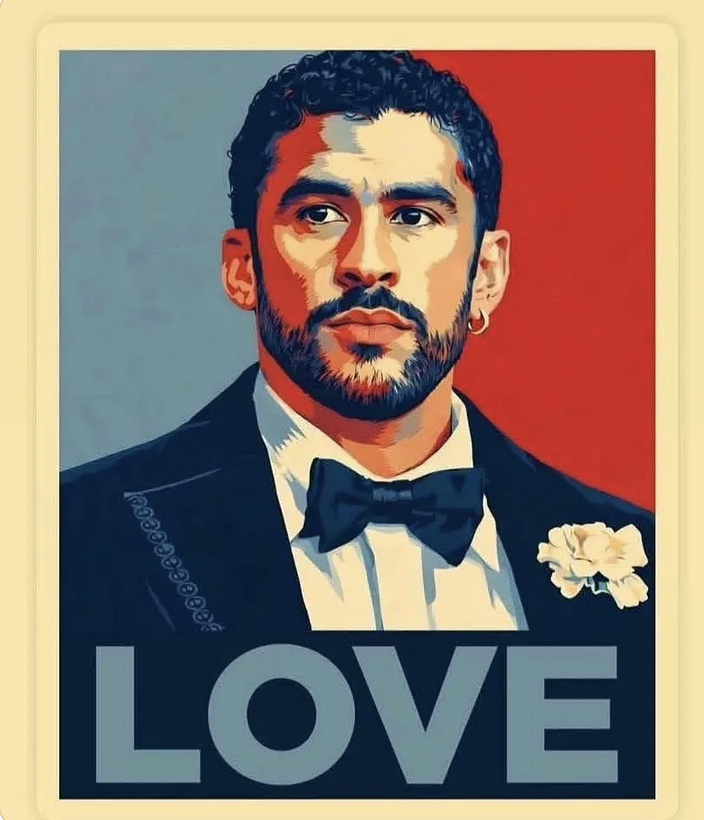
At the 2026 Super Bowl halftime show, Bad Bunny used one of the most visible stages in United States popular culture to advance a political argument. The performance did not call for legislation or issue a formal declaration. Instead, it intervened at the level of political imagination by reframing “America” as hemispheric and presenting joy as a deliberate mode of collective assertion.
By expanding the meaning of “America” beyond the United States, the performance challenged the assumption that national borders define the limits of belonging. It also raised a broader question: what shifts when a political community is imagined across the Americas rather than confined to a single state?
America Was Never Just One Thing
“America” designated a geographic space before it came to signify a collective identity. In early modern cartography, the term identified newly incorporated landmasses within European epistemological frameworks rather than a distinct people or sovereign polity. Over time, particularly in English usage, the word narrowed to denote the United States alone.
This contraction was not neutral. “America” emerged through practices of naming, mapping, and narration embedded in colonial authority. As the United States consolidated economic and geopolitical influence, the singular America increasingly operated as shorthand for the hemisphere itself.
The halftime performance disrupted that equivalence. By invoking locations across North and South America and centering Spanish-language soundscapes, Bad Bunny restored the term’s broader geographic reference. The gesture did not rely on institutional validation or theoretical language. It functioned as cultural reclamation, unsettling the presumption that “America” and the United States are interchangeable.
Joy as Political Practice
Joy is frequently treated as apolitical, described as expressive rather than consequential. Protest is characterized as direct and confrontational, while joy is framed as ornamental or private. That distinction collapses when joy appears in spaces that have historically excluded particular languages, bodies, and cultural forms. Within Black and Latinx intellectual traditions, joy has long operated as a public assertion of humanity under conditions that restrict recognition.
In this context, celebration does not serve as relief from hardship. It rejects reducing marginalized communities to narratives of suffering. Public joy affirms continued presence and expands political imagination beyond endurance. Bad Bunny’s decision to lead with dance, movement, and communal, deeply rooted sound did not dilute the substance of his claim. It clarified it by rendering the argument perceptible.
On that stage, joy became a mode of collective articulation. The hemispheric “we” was not only described; it was made tangible.
A Hemispheric “We”
Conceiving America as hemispheric does not eliminate difference. It requires acknowledgment of interconnected histories that traverse borders, including colonial extraction, forced migration, cultural persistence, and structural inequality. It also foregrounds shared futures shaped by climate disruption, economic interdependence, and migration.
When artists articulate a broader “we,” they engage in a form of cultural diplomacy. This is not diplomacy in the treaty sense but in the reshaping of belonging through symbolic practice. Such reframing matters because public imagination influences whose labor is valued, whose mobility is criminalized, and whose culture is treated as foundational rather than peripheral.
The history of Pan-Americanism demonstrates the risks embedded in hemispheric language. Appeals to unity have often masked asymmetrical power, particularly when integration is defined on United States terms. Any inclusive frame can become a rhetorical cover for dominance if it ignores structural imbalance. The performance avoided that dynamic because the claim did not originate from the state and did not prescribe governance. It advanced recognition without demanding uniformity.
Conclusion
Cultural performances do not substitute for institutional reform. Their significance lies in their capacity to reshape interpretive frameworks. By challenging assumptions that appear settled, they expose political arrangements as contingent rather than inevitable.
This moment is consequential because it contests a constricted account of belonging. As nationalist discourse narrows definitions of membership, reclaiming “America” as hemispheric recalibrates the scale at which solidarity is imagined. The shift is not merely lexical. It questions the assumption that obligation ends at the border.
Joy, in this framework, does not function as escape. It operates as a method. Through music and movement, the performance articulated an understanding of “America” as plural and relational rather than singular and proprietary. It demonstrated that cultural practice can render alternative political imaginaries coherent, even when institutional structures remain unchanged.
Sources and Further Reading
Almagià, Roberto. “Amerigo Vespucci.” Encyclopaedia Britannica, 1 Jan. 2026, www.britannica.com/biography/Amerigo-Vespucci.
Avila, Daniela, and Meredith Kile. “Bad Bunny’s Halftime Show Mostly Avoids Politics, Leans Into Joy: Here’s What He Said Instead.” People, 8 Feb. 2026, people.com/super-bowl-2026-halftime-show-bad-bunny-leans-into-joy-over-politics-11902110.
Beltrán, Cristina. The Trouble with Unity: Latino Politics and the Creation of Identity. Oxford UP, 2010. https://archive.org/details/troublewithunity0000belt.
Chan, Anna. “Watch Bad Bunny’s Super Bowl LX Halftime Show.” Pitchfork, 8 Feb. 2026, pitchfork.com/news/watch-bad-bunnys-super-bowl-lx-halftime-show/.
Díaz, Vanessa, and Petra R. Rivera-Rideau. P FKN R: How Bad Bunny Became the Global Voice of Puerto Rican Resistance. Duke UP, Jan. 2026. https://www.dukeupress.edu/p-fkn-r.
Gallardo, Adriana, A. Martínez, and Lilly Quiroz. “‘A Party and a Protest’: What to Expect from Bad Bunny on Super Bowl Sunday.” WSKG, 6 Feb. 2026, www.wskg.org/npr-news/2026-02-06/a-party-and-a-protest-what-to-expect-from-bad-bunny-on-super-bowl-sunday.
Maldonado-Salcedo, Melissa. “Bad Bunny and the Politics of Joyful Resistance.” NACLA, 7 Nov. 2025, nacla.org/bad-bunny-and-the-politics-of-joyful-resistance/.
Mignolo, Walter D. The Idea of Latin America. John Wiley & Sons, 2005. https://www.wiley.com/en-us/The+Idea+of+Latin+America-p-9781405100854.
O’Gorman, Edmundo. The Invention of America: An Inquiry into the Historical Nature of the New World and the Meaning of Its History. Indiana UP, 1961. https://archive.org/details/inventionofameri0000ogor/page/6/mode/2up.
O’Keefe, Thomas Andrew. “The Inter-American System in an Era of Declining United States Hegemony.” Middle Atlantic Review of Latin American Studies, vol. 4, no. 2, 2020, pp. 194–212. Middle Atlantic Council of Latin American Studies, doi:10.23870/marlas.307.
Organization of American States. Charter of the Organization of American States. 30 Apr. 1948, www.oas.org/sap/peacefund/VirtualLibrary/KeyPeaceInstruments/CharterOAS/CharterofOAS.pdf. Accessed 9 Feb. 2026.
Wynter, Sylvia. “Unsettling the Coloniality of Being/Power/Truth/Freedom: Towards the Human, After Man, Its Overrepresentation—An Argument.” The New Centennial Review, vol. 3, no. 3, Fall 2003, pp. 257–337. Michigan State UP, doi:10.1353/ncr.2004.0015.
Leave a Reply