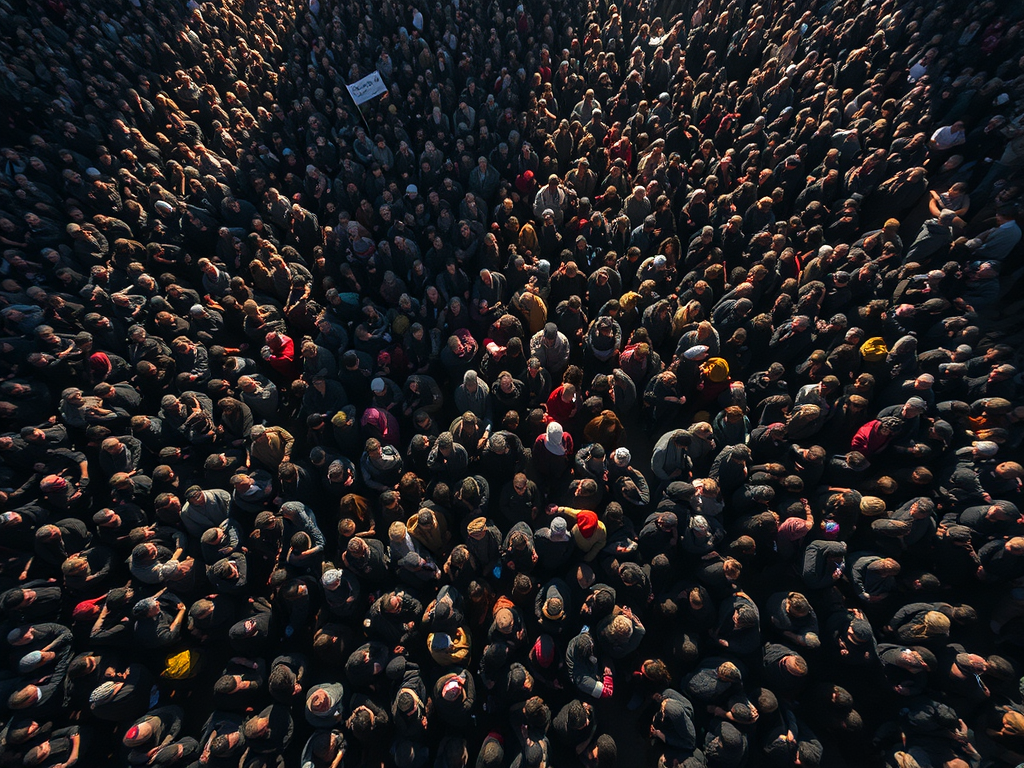
Participation plays a central role in how many high-control regimes govern. Citizens are expected to work, join organizations, attend public rituals, and reproduce official norms in schools and workplaces. This expectation is especially pronounced in totalitarian and mobilizational authoritarian systems that seek not merely obedience but visible alignment (Linz). Yet the same regimes that demand participation punish dissent, restrict information, and control access to resources. The behaviors on which these systems depend are therefore produced under conditions that make it difficult to determine whether participation reflects belief, strategy, or fear.
This ambiguity complicates a common assumption in political analysis, namely that visible cooperation signals popular support. In high-control settings, participation may be compulsory, materially incentivized, or performed to avoid punishment (Wedeen). Voting, applause, organizational membership, and loyalty rituals can coexist with private doubt or opposition (Kuran). When these acts are treated as evidence of consent, observers misread how power operates under coercive institutional conditions.
Stability under such systems depends less on belief than on incentive design. Repression is paired with institutions that structure information, material access, and public behavior so that cooperation remains safer, more predictable, and more legible than refusal (Linz). Dissent is not eliminated. It is rendered costly, fragmented, and difficult to coordinate. This dynamic helps explain why regimes marked by repression can appear stable and why collapse often surprises those who mistake managed participation for belief (Kuran).
Moments of crisis often provide the conditions for this form of rule to consolidate. War, economic collapse, or political paralysis can make restoring order a broadly shared demand rather than a purely elite project (Holquist). Emergency measures such as censorship, suspension of legal protections, and concentration of executive authority are introduced as provisional responses but often become durable features of governance (Linz). Under these conditions, high-control rule is justified less as domination than as necessity.
Early twentieth-century Russia illustrates this pattern. World War I and the revolutionary period that followed produced prolonged instability, making centralized authority appear essential for basic governance (Holquist). After October 1917, Bolshevik consolidation proceeded not through a durable coalition but through the marginalization and elimination of rival socialist factions (Fitzpatrick, The Russian Revolution). Appeals to unity during crisis thus functioned less as inclusion than as instruments of exclusion and boundary enforcement.
Control over information sustains this arrangement. In such systems, propaganda functions not only as persuasion but as governance (Ellul). Schools, media regulation, public ritual, and censorship restrict interpretive frameworks and narrow what can be safely said. The objective is rarely universal belief. Instead, disagreement is contained, and public behavior is channeled into predictable scripts that institutions can monitor and enforce (Linz).
In Stalin’s Soviet Union, this logic converged with leader-centered legitimation. Stalin was positioned as the authoritative source of truth and national purpose, rendering criticism a moral and political offense (Plamper). These constraints shaped everyday life and elite discourse, influencing how individuals navigated risk in ordinary settings (Fitzpatrick, Everyday Stalinism). Nazi Germany employed comparable techniques with different ideological content, framing war and repression as a defensive necessity against an existential enemy (Herf). Earlier regimes such as Augustan Rome relied on analogous symbolic strategies, using controlled visual environments to associate rule with restoration and historical inevitability (Zanker).
Material dependence further reinforces participation. In many high-control systems, particularly state-socialist and mobilization regimes, the state becomes a central administrator of access to employment, housing, education, and goods (Kornai). Political compliance becomes a condition of security and mobility, enforced through bureaucratic mechanisms rather than constant violence. Under Stalinism, sanctions such as job reassignment, housing loss, or exclusion from institutions encouraged conformity without requiring ideological conversion (Fitzpatrick, Everyday Stalinism).
This administrative leverage also sorts populations by political reliability. Some groups are shielded through privileges and protected access, while others face heightened vulnerability (Kotkin). Those who benefit from the system acquire incentives to sustain it even in the absence of strong ideological commitment. Comparable dynamics persist in contemporary cases such as North Korea, where public compliance is often necessary for safety regardless of private belief (Lankov).
Surveillance and repression reshape social life by altering what individuals believe it is safe to say. Informant networks and the threat of punishment encourage self-censorship and make it difficult to infer others’ beliefs (Khlevniuk). Public behavior becomes strategic rather than expressive, with conformity functioning as risk management rather than endorsement.
Timur Kuran describes this dynamic as preference falsification. Individuals misrepresent their views publicly because honesty is dangerous (Kuran). When dissent remains hidden and compliance visible, a false appearance of consensus can persist even when private doubt is widespread. Lisa Wedeen shows how ritualized participation reinforces this effect by transforming public acts into tests of obedience that institutions can observe and sanction (Wedeen).
Outward participation, however, does not arise from a single motive. The same acts may reflect belief, benefit seeking, conformity, institutional performance, or exhaustion. These motives often overlap and shift as risks and rewards change. For this reason, participation is a poor proxy for consent and an unreliable indicator of regime legitimacy (Linz).
Compliance endures only as long as cooperation remains safer or more predictable than refusal. It weakens when regimes demand more than they can deliver, when official narratives lose credibility, when enforcement becomes uneven due to capacity constraints or factional conflict, or when elite fragmentation undermines assumptions of coordinated control (Linz; Kuran). These processes do not guarantee democratization, but they help explain why ritualized compliance can give way to withdrawal or resistance with surprising speed.
In high-control systems, what can be seen is already shaped by power. When loyalty is demanded and dissent penalized, public behavior reflects compliance far more reliably than belief. Affirmation is visible while doubt is concealed (Wedeen). This distortion encourages a common error: treating organized participation as evidence of consensus (Kuran). Stability may therefore be partly performative, and change may appear abrupt when private disaffection becomes visible as institutional control weakens. Participation is better interpreted as adaptation to fear, incentives, and constraints than as proof of shared conviction. Change, therefore, does not depend on reshaping public opinion; it requires disrupting the mechanisms that make compliance the safest option.
Sources and Further Reading
Arendt, Hannah. The Origins of Totalitarianism. Schocken Books, 1951.
https://openlibrary.org/works/OL45804W/The_Origins_of_Totalitarianism
Ellul, Jacques. Propaganda: The Formation of Men’s Attitudes. Translated by Konrad Kellen and Jean Lerner, Knopf, 1965.
https://books.google.com/books?id=yKfZAAAAMAAJ
Fitzpatrick, Sheila. Everyday Stalinism: Ordinary Life in Extraordinary Times. Oxford University Press, 1999.
https://academic.oup.com/book/47328
Fitzpatrick, Sheila. The Russian Revolution. Oxford University Press, 2001.
https://academic.oup.com/book/47739
Herf, Jeffrey. The Jewish Enemy: Nazi Propaganda during World War II and the Holocaust. Harvard University Press, 2006.
https://www.hup.harvard.edu/books/9780674027381
Holquist, Peter. Making War, Forging Revolution: Russia’s Continuum of Crisis, 1914–1921. Harvard University Press, 2002.
https://www.hup.harvard.edu/books/9780674009073
Khlevniuk, Oleg V. Stalin: New Biography of a Dictator. Yale University Press, 2015.
https://yalebooks.yale.edu/book/9780300219784
Kornai, János. The Socialist System: The Political Economy of Communism. Princeton University Press, 1992.
https://press.princeton.edu/books/paperback/9780691003931
Kotkin, Stephen. Magnetic Mountain: Stalinism as a Civilization. University of California Press, 1995.
https://publishing.cdlib.org/ucpressebooks/view?docId=ft4h4nb2w4
Kuran, Timur. Private Truths, Public Lies: The Social Consequences of Preference Falsification. Harvard University Press, 1995.
https://archive.org/details/privatetruthspub0000kura
Lankov, Andrei. The Real North Korea: Life and Politics in the Failed Stalinist Utopia. Oxford University Press, 2013.
https://global.oup.com/academic/product/the-real-north-korea-9780199390038
Linz, Juan J. Totalitarian and Authoritarian Regimes. Lynne Rienner Publishers, 2000.
https://www.rienner.com/title/Totalitarian_and_Authoritarian_Regimes
Plamper, Jan. The Stalin Cult: A Study in the Alchemy of Power. Yale University Press, 2012.
https://yalebooks.yale.edu/book/9780300169522
Wedeen, Lisa. Ambiguities of Domination: Politics, Rhetoric, and Symbols in Contemporary Syria. University of Chicago Press, 1999.
https://press.uchicago.edu/ucp/books/book/chicago/A/bo22776830.html
Zanker, Paul. The Power of Images in the Age of Augustus. University of Michigan Press, 1988.
https://archive.org/details/powerofimagesina0000zank
Leave a Reply