By Winston Vance
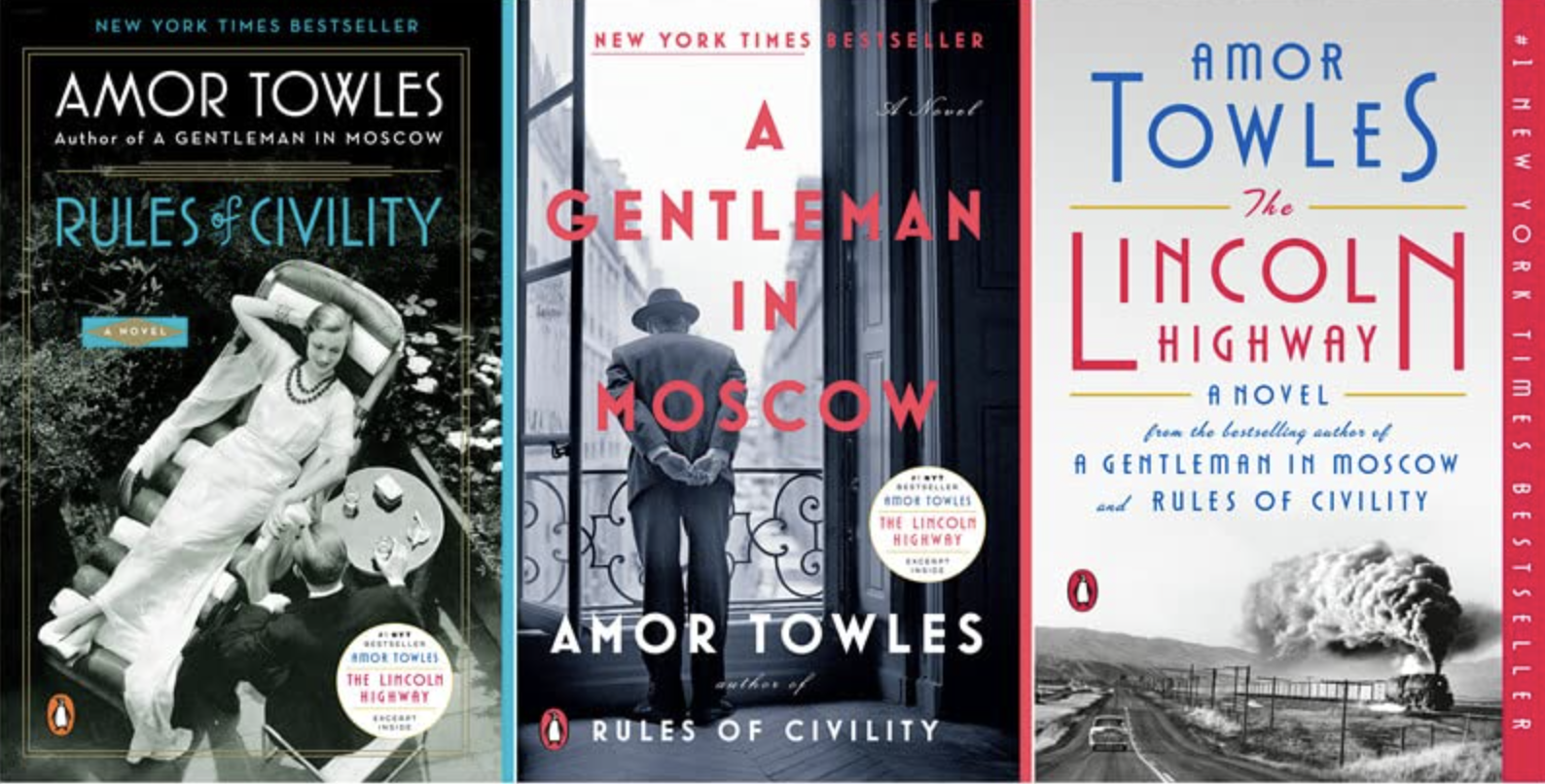
Across Amor Towles’s fiction, refinement is never simply a matter of taste. It is a system—an economy of manners, labor, and constraint that defines who can appear effortless and who must work to make that appearance possible. In Rules of Civility, A Gentleman in Moscow, and The Lincoln Highway, polish depends on infrastructure: service work, ritual, and social order. When Towles’s characters find dignity, it arises not from privilege but from resourcefulness despite limits.
New York: Glamour and Outsiders
Towles’s debut, Rules of Civility (2011), frames the story with a 1966 Walker Evans exhibition before returning to the 1937–38 nightlife—jazz clubs, cabs, and the 21 Club. It is a world of cocktails, repartee, and possibility. Yet the narrator, Katey Kontent, never forgets her outsider status. The daughter of Russian immigrants, she enters elite circles by chance and remains aware that she does not fully belong.
Katey notices how allure is manufactured more than inherited:
“In New York it becomes so easy to assume that the city’s most alluring women have flown in from Paris or Milan. But they’re just a minority. A much larger covey hails from the stalwart states that begin with the letter I—like Iowa and Indiana and Illinois” (Rules of Civility 114).
The observation is amused but unsparing: sophistication rests as much on perception and gatekeeping as on origin. Towles also underscores the limits of aspiration. Reflecting on how youth shapes choices, Katey notes:
“In our twenties … the deck has been played out and the decisions we have just made will shape our lives for decades to come” (Rules of Civility 323).
Her world may glitter, but it does not belong to her; she moves in and out of it by luck and circumstance.
Moscow: Civility Under Pressure
Where Rules of Civility ends with motion, A Gentleman in Moscow opens with confinement. Spared execution by a technicality, Count Alexander Rostov is sentenced to life inside the Metropol Hotel. The Metropol contains a miniature polity: maître d’, chef, seamstress, barber, and the inquisitive child Nina with her passkey. Rituals remain, such as shaving with care and lingering over a meal, but their meaning shifts. Courtesy becomes coordination; polish depends on provisioning and timing performed by others. Early on, Rostov voices an ethic suited to his new constraints:
“Adversity presents itself in many forms; and that if a man does not master his circumstances then he is bound to be mastered by them” (A Gentleman in Moscow 18).
As Rostov learns to collaborate with staff he once treated as background, Towles recasts gentility as a learned practice of endurance. A later reflection extends that lesson to human regard:
“By their very nature, human beings are so capricious, so complex, so delightfully contradictory, that they deserve not only our consideration, but our reconsideration—” (A Gentleman in Moscow 120).
The hotel’s elegance reveals its dependence on hidden corridors, schedules, and compromises. Civility is sustained less by pedigree than by shared ingenuity.
America: Roads and Their Limits
The Lincoln Highway sets itself against the mythology of the open road. Emmett Watson, newly released from a juvenile work farm, plans to head west with his younger brother, only to be diverted by old debts and new obligations. The road extends, yet the choices narrow; travel does not guarantee freedom, and stillness offers no shelter. Towles gives the book a compact moral:
“For kindness begins where necessity ends” (The Lincoln Highway 104).
Scarcity limits generosity because responsibility leaves little room for grace. Even the book’s central image resists turning into myth. The first transcontinental car route, for example, runs from Times Square to Lincoln Park in San Francisco. Taken literally, it doesn’t reach the Pacific Ocean but stops at a city park. That planned ending feels like an interruption—a reminder that American mobility has always been shaped by institutions and histories that decide who gets to keep moving and who must stop.
Style or Substance?
Critics are divided. Some read Towles as escapist, drawn to atmosphere; others argue that his surfaces sharpen civic stakes. The first group points to cinematic detail and charming set pieces. The second notes that Katey’s immigrant background resists nostalgia, that the Metropol’s rituals rely on staff labor, and that the highway story dismantles reinvention myths through detours and debt. The debate often turns on what “style” does. If style only decorates, the novels risk ornament. If style exposes the structures that sustain it, refinement becomes Towles’s way of testing ethics.
Contemporary Relevance
Though set in the past, these novels speak directly to the present. A Gentleman in Moscow works as a parable of adaptation under constraint. Rules of Civility shows how ambition is shaped by curation and access. The Lincoln Highway punctures the national story of universal mobility, revealing it as something historically rationed. In each, outsiders bring the perspective: Katey’s vantage exposes the cost of entry; Nina’s passkey charts the hotel’s hidden circuits; Duchess’s ledger turns the road into an economy of obligation. Towles’s fiction reminds us that history provides the frameworks within which choices unfold. Elegance does not rise above those frameworks; it rests on them.
Towles’s Novels in Summary
Across three very different settings, Towles’s subject is not style alone, but the resourcefulness by which people preserve dignity when options are diminished. Parties, rituals, and highways beckon, but class, chance, and law establish limits. Read this way, refinement is not simply escapist. Instead, Towles uses contrast to examine the infrastructures that make certain lives look effortless and other lives invisible, asking what courtesy, decency, and resilience mean in unequal circumstances.
For more literary reviews, see this post on Toni Morrison’s novel, Sula, & this discussion of Kurt Vonnegut’s short story Harrison Bergeron.
Sources and Further Reading
Alter, Alexandra. “Amor Towles on Crafting Fiction with Restraint.” The New York Times, 4 Nov. 2021, nytimes.com/2021/11/04/books/amor-towles-lincoln-highway.html.
Boym, Svetlana. The Future of Nostalgia. Basic Books, 2001, archive.org/details/futureofnostalgi00boym.
Gopnik, Adam. A Thousand Small Sanities: The Moral Adventure of Liberalism. Basic Books, 2019, basicbooks.com/titles/adam-gopnik/a-thousand-small-sanities/9781541699366/.
Gross, Terry. “Amor Towles Finds Freedom on The Lincoln Highway.” Fresh Air, NPR, 12 Oct. 2021, npr.org/2021/10/12/1045250204/amor-towles-finds-freedom-on-the-lincoln-highway.
Kakutani, Michiko. “Rules of Civility by Amor Towles.” The New York Times, 25 July 2011, nytimes.com/2011/07/26/books/rules-of-civility-by-amor-towles-review.html.
Schillinger, Liesl. “A Gentleman in Moscow by Amor Towles.” The New York Times, 6 Sept. 2016, nytimes.com/2016/09/06/books/review-a-gentleman-in-moscow-amor-towles.html.
Seaman, Donna. “The Lincoln Highway.” Booklist, 1 Nov. 2021, booklistonline.com/The-Lincoln-Highway/pid=9748380.
Towles, Amor. A Gentleman in Moscow. Viking, 2016. Penguin Random House, penguinrandomhouse.com/books/311564/a-gentleman-in-moscow-by-amor-towles.
Towles, Amor. The Lincoln Highway. Viking, 2021. Penguin Random House, penguinrandomhouse.com/books/549384/the-lincoln-highway-by-amor-towles.
Towles, Amor. Rules of Civility. Viking, 2011. Penguin Random House, penguinrandomhouse.com/books/308487/rules-of-civility-by-amor-towles.
Wilson, Elizabeth. Bohemians: The Glamorous Outcasts. Rutgers University Press, 2000, rutgersuniversitypress.org/bohemians/9780813527046.
Leave a Reply