By Travis Vance
“The Carrier Piegon” (“Oh! qu’est-ce que c’est donc que l’Inconnu.”)
Who then – oh, who, is like our God so great,
Who makes the seed expand beneath the mountain’s weight;
Who for a swallow’s nest leaves one old castle wall,
Who lets for famished beetles savory apples fall,
Who bids a pigmy win where Titans fail, in yoke,
And, in what we deem fruitless roar and smoke,
Makes Etna, Chimborazo, still His praises sing,
And saves a city by a word lapped ‘neath a pigeon’s wing!
– Victor-Marie Hugo, 1871
Carrier pigeons formed a vital global network for military, political, and state communication for over 4,000 years—from ancient Mesopotamia around 2500 BCE into the 20th century, when the U.S. Army decommissioned its last pigeon unit in 1957 (U.S. Army, 2012). Across wars and continents, they delivered urgent messages when no other system could. Yet within decades, this ancient communication network was dismantled and supplanted by cables, circuits, and eventually satellites. Today, pigeons gather on rooftops and in city parks, their millennia-long role in human communication largely forgotten.
That such a system could vanish so thoroughly, and leave barely a trace in collective memory, reveals a larger truth. What seems essential in one era can become obsolete in the next, when it is displaced by a more innovative model. The transition away from pigeons reveals a recurring dynamic: technology displaces biological systems while modeling its designs on the capabilities it replaces. This pattern is evident today in the design of autonomous systems, where machine learning models and drone architectures mimic natural navigation strategies once demonstrated by birds (Todorovic et al. 2021).
The pigeons’ success had relied not on electricity or engines, but on evolutionary adaptation, structured training, and human trust. That ecosystem has since vanished, replaced by programmable systems that imitate aspects of natural intelligence while depending on artificial inputs.
This essay traces the pigeon’s role across empires and eras. It also asks how communication, once embedded in biology, gave way to silicon and software.
A Natural Engineering System
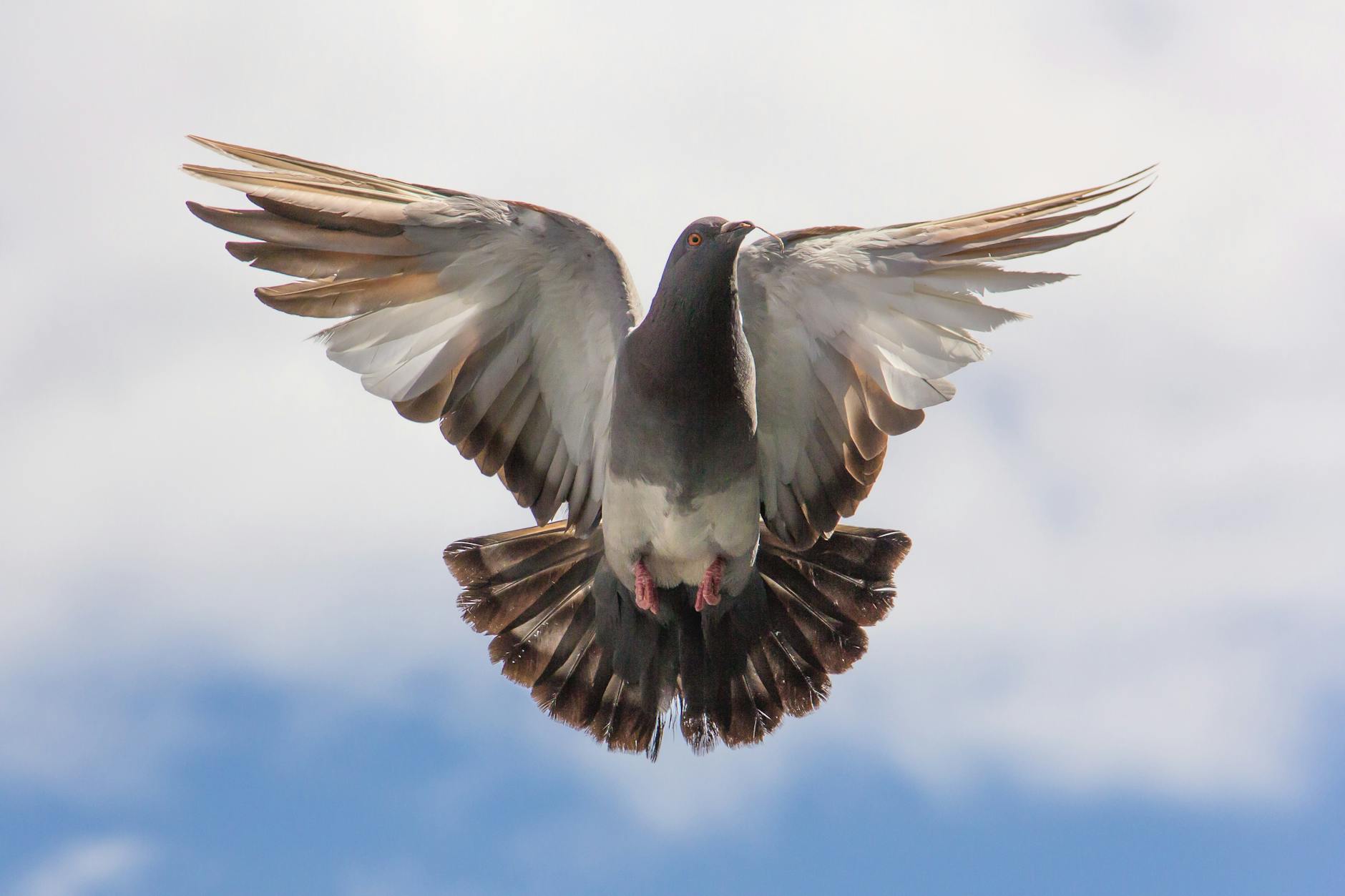
Carrier pigeons are a domesticated form of the rock dove, also known as Columba livia. Their navigational abilities draw on magnetoreception, solar orientation, and olfactory mapping. Foundational studies by Keeton 1971, Wiltschko and Wiltschko 1995, and Gagliardo 2013 show how these inputs combine to produce consistent spatial awareness. Also, the pigeon’s cognitive architecture is distributed, adaptive, and robust under environmental stress.
Capable of traveling hundreds of miles and navigating through fog, storms, and unfamiliar terrain, pigeons process ambient data into spatial knowledge without mechanical calibration (Lyon 1944). So, with proper training, they become reliable messengers.
Historian Frank Blazich calls them a form of “biological infrastructure,” evolved to operate without artificial inputs while sustaining coordinated information transfer across distance.

Messaging Across Empires
Pigeons belonged to an earlier stage of innovation: an organic solution that extended communication beyond the limits of line-of-sight and terrain. Before them, long-distance messaging depended on fire beacons, coded drums, and human couriers. Civilizations such as Persia and Rome developed horseback relay systems with remarkable speed for their time, though these networks were vulnerable to interception, delay, and terrain.
However, pigeons introduced a fundamentally different model—portable, discreet, and untethered to fixed routes. Their use dates back to ancient Mesopotamia around 2500 BCE, where they carried long-distance messages (Aharoni 2009). The Persians later used them for military signaling across expanding territories. The Romans formalized pigeon messaging within their imperial relay networks; Pliny the Elder, in Natural History (Book 10, Chapter 24), recounts how Decimus Brutus used pigeons to send messages during the siege of Modena in 43 BCE, an early recorded example of their role in state communication (Loeb Classical Library).
By the nineteenth century, pigeon networks reemerged in military operations. Napoleon’s forces used them during the Napoleonic Wars. During the Franco-Prussian War of 1870–71, besieged Parisians famously launched pigeons by balloon to bypass enemy lines and receive microfilmed replies (Clifton-Morekis 2021).
In the twentieth century, their operational role expanded dramatically. Lofts were installed on trucks, ships, and field bases. Also, messages were encrypted and sealed in lightweight capsules attached to the pigeons’ legs, as noted by America in WWII. Missions spanned theaters including Normandy, North Africa, and Burma (now Myanmar), with delivery success rates between 85 and 95 percent (U.S. Army records).
In many cases, pigeons remained the last functioning channel for message delivery. When radios failed or cables were severed, they carried confirmations, warnings, and calls for rescue. Though recognized in battle, their labor, both avian and human, remains largely unrecorded.
Training, Deployment, and Risk
The effectiveness of carrier pigeons as a communication technology depended not only on their biology but also on the rigor of their conditioning and the scale of logistical support around them. Unlike passive systems such as cables or radios, pigeons required active behavioral shaping, environmental control, and constant oversight. Birds were imprinted on specific home lofts through early exposure to a single location, ensuring a reliable homing instinct. Also, handlers reinforced this through hunger cycles, mate bonding, and repetitive flight drills, often staggering feeding schedules and limiting social contact to heighten motivation. So, the deployment demanded precise planning around terrain, weather, and range.
This reliability carried significant cost. A recent study by Laura Peng documents coercive training protocols used by Japan’s Imperial Navy during World War II—including forced nocturnal flights and isolation chambers to intensify dependency on human handlers (Peng). Mortality rates during training were often high, especially when birds failed to orient under artificial pressure. Even in Allied systems, losses were common due to exhaustion, injury, weather, or predation. Yet pigeons often outperformed early mechanical alternatives in reliability across difficult terrain (“Pigeons of War”).
Their strategic value prompted dedicated countermeasures. During both World Wars, militaries developed anti-pigeon units tasked with intercepting birds suspected of carrying sensitive messages. In occupied France and Belgium, German forces stationed sentries along known loft routes, and some pigeons were even intercepted mid-flight and used to plant false messages (“Pigeons of War”). Also, in Britain, MI5 trained peregrine falcons to take down enemy birds mid-air as part of a formal interception program (War History Online). Elsewhere, hawks and other raptors were used to disrupt avian message traffic, integrating natural predators into structured counterintelligence efforts (World War Supply).
From Pigeon to Protocol
As Clifton-Morekis (2021) notes, pigeon communication required significant infrastructure: mobile lofts, encrypted messages, and trained personnel. So vital was this system that German forces in World War I deployed falcons and sharpshooters to intercept pigeons mid-flight. Many completed their missions despite these threats. Some records remain. The Smithsonian Institution displays the preserved body of Cher Ami, a pigeon credited with saving nearly 200 U.S. soldiers during the Meuse-Argonne offensive in 1918. Despite being shot through the breast, blinded in one eye, and with a leg hanging by a tendon, she delivered her message—an act that earned her the Croix de Guerre with palm for heroic service.
Across the Atlantic, the UK’s Imperial War Museums house medals and message capsules used by pigeons such as Commando, who completed more than ninety missions into Nazi-occupied France. So, for repeatedly evading enemy fire to deliver critical intelligence, he received the Dickin Medal, often referred to as the animal equivalent of the Victoria Cross. In total, more than thirty pigeons received this distinction for their wartime contributions. Others disappeared in transit, unrecognized but essential: small lives folded into the hidden architecture of war logistics, where survival was often the only record of success.
By the mid-twentieth century, pigeons were phased out as militaries adopted radio and digital systems. This shift marked more than a change in tools; it reflected a transition from evolved autonomy to engineered control. Pigeons required no servers, no signals, and no written code. Also, their intelligence emerged from direct interaction with the physical world. Contemporary drone systems now incorporate pigeon-like strategies: real-time feedback, multisensory input, adaptive mapping. One such framework, described in Todorovic et al. (2021), explores biologically inspired navigation for autonomous systems. These efforts reflect a broader trend identified earlier in this essay: the attempt to formalize and reproduce capabilities that once emerged from embodied, biological systems. Yet drones remain dependent on stored instructions and external computation. The pigeon’s model offers something modern systems still struggle to replicate: reliability without infrastructure.
Conclusion: Legacy and Erasure
Pigeon communication was not a stopgap; it represented a global network characterized by logistical sophistication and proven resilience. It didn’t disappear due to failures but was replaced by tools engineered for speed, automation, and centralized control. As these technologies evolved, the framework it once upheld gradually faded from sight.
This is more than a historical footnote. The systems we use today face similar risks of obsolescence. Innovation often outpaces analysis, allowing durable models to vanish without scrutiny or record. The rise and disappearance of the pigeon network shows how easily critical infrastructure, and the intelligence it embodied, can be forgotten—even when it once enabled reliable, large-scale information transfer.

Sources and Further Reading
Aharoni, Reuben. “Pigeons and the History of Communication.” IEEE Global History Network, 2009, https://ethw.org/Pigeons_and_the_History_of_Communication.
“America in WWII. ‘Pigeons of War.’” America in WWII, https://www.americainwwii.com/articles/pigeons-of-war/.
“Army.mil. ‘CECOM History Is for the Birds: Hero Pigeons.’” U.S. Army, https://www.army.mil/article/74924/cecom_history_is_for_the_birds_hero_pigeons.
BBC News. “World War II Carrier Pigeon Message Found in Chimney.” BBC News, 17 Feb. 2012, https://www.bbc.com/news/uk-scotland-tayside-central-17138990.
Blazich, Frank A. Jr. “Feathers and Formats: Information, Technology, and Homing Pigeons in War.” The Routledge Handbook of Information History, edited by Toni Weller, Taylor & Francis, 2025, https://www.taylorfrancis.com/chapters/edit/10.4324/9781003310532-37/feathers-formats-frank-blazich.
“Cher Ami, Carrier Pigeon, World War I.” National Museum of American History, Smithsonian Institution, https://www.si.edu/object/nmah_425415.
Clifton-Morekis, Samuel. “Front-line Fowl: Messenger Pigeons as Communications Technology in the U.S. Army.” History and Technology, vol. 37, no. 2, 2021, pp. 241–267. Taylor & Francis, https://doi.org/10.1080/07341512.2021.1898896.
Gagliardo, Anna. “Forty Years of Olfactory Navigation in Birds.” Journal of Experimental Biology, vol. 216, no. 12, 2013, pp. 2165–2171. https://doi.org/10.1242/jeb.070250.
Headrick, Daniel R. The Invisible Weapon: Telecommunications and International Politics, 1851–1945. Oxford UP, 1991. https://archive.org/details/invisibleweapon00head
Hugo, Victor. The Carrier Pigeon. InternetPoem.com, January 1871, https://internetpoem.com/victor-marie-hugo/the-carrier-pigeon-poem/.
Innis, Harold A. Empire and Communications. 2nd ed., University of Toronto Press, 1972. Internet Archive, https://archive.org/details/empirecommunicat0000inni.
Keeton, William T. “Magnets Interfere with Pigeon Homing.” Proceedings of the National Academy of Sciences, vol. 68, no. 1, 1971, pp. 102–106. https://doi.org/10.1073/pnas.68.1.102.
Lyon, Ju. “The Homing Ability of the Carrier Pigeon: Its Value in Warfare.” The Wilson Bulletin, vol. 56, no. 3, 1944, pp. 169–174. JSTOR, https://www.jstor.org/stable/4079708.
Peng, Laura. “Feathered Fighters: How the Carrier Pigeon Helped Win WWII.” USBA Blog, https://www.usba.com/blog/356/feathered-fighters-how-the-carrier-pigeon-helped-win-wwii.
Peng, Laura. “The Impact of War on Animal Welfare: The Imperial Japanese Navy’s Manipulation of Pigeon Behavior.” Nature Humanities and Social Sciences Communications, 2025, https://doi.org/10.1057/s41599-025-04397-8.
Pliny the Elder. Natural History. Translated by H. Rackham, Loeb Classical Library, vol. 3, Harvard UP, 1945, https://archive.org/details/naturalhistory03plin/page/n5/mode/2up.
Seattle Times Archive. “His Feathered Forces Helped Shorten World War II.” The Seattle Times, https://archive.seattletimes.com/archive/19900615/1077308/his-feathered-forces-helped-shorten-world-war-ii.
Todorovic, Sinisa, et al. “Biologically-Inspired Navigation for Autonomous Drones: Toward Pigeon-Like Spatial Intelligence.” In Biologically Inspired Cognitive Architectures 2021, edited by Alexei V. Samsonovich, Springer, 2021, pp. 151–161. https://doi.org/10.1007/978-3-030-71393-5_14.
“War History Online. ‘MI5 Trained Falcons to Intercept Nazi Spy Pigeons.’” War History Online, https://www.warhistoryonline.com/world-war-ii/mi5-falcons.html.
Wikipedia contributors. “National Pigeon Service.” Wikipedia, https://en.wikipedia.org/wiki/National_Pigeon_Service.
Wiltschko, R., and Wiltschko, W. “Magnetoreception and Its Use in Bird Navigation.” Journal of Comparative Physiology A, vol. 177, no. 3, 1995, pp. 319–324. https://doi.org/10.1007/BF00207198.
“World War Supply. ‘Falcons in the Skies: Training Raptors to Intercept Carrier Pigeons During WWII.’” World War Supply, https://www.worldwarsupply.com/2024/01/falcons-in-the-skies-training-raptors-to-intercept-carrier-pigeons-during-wwii.
Leave a Reply