By Declan McDonnell
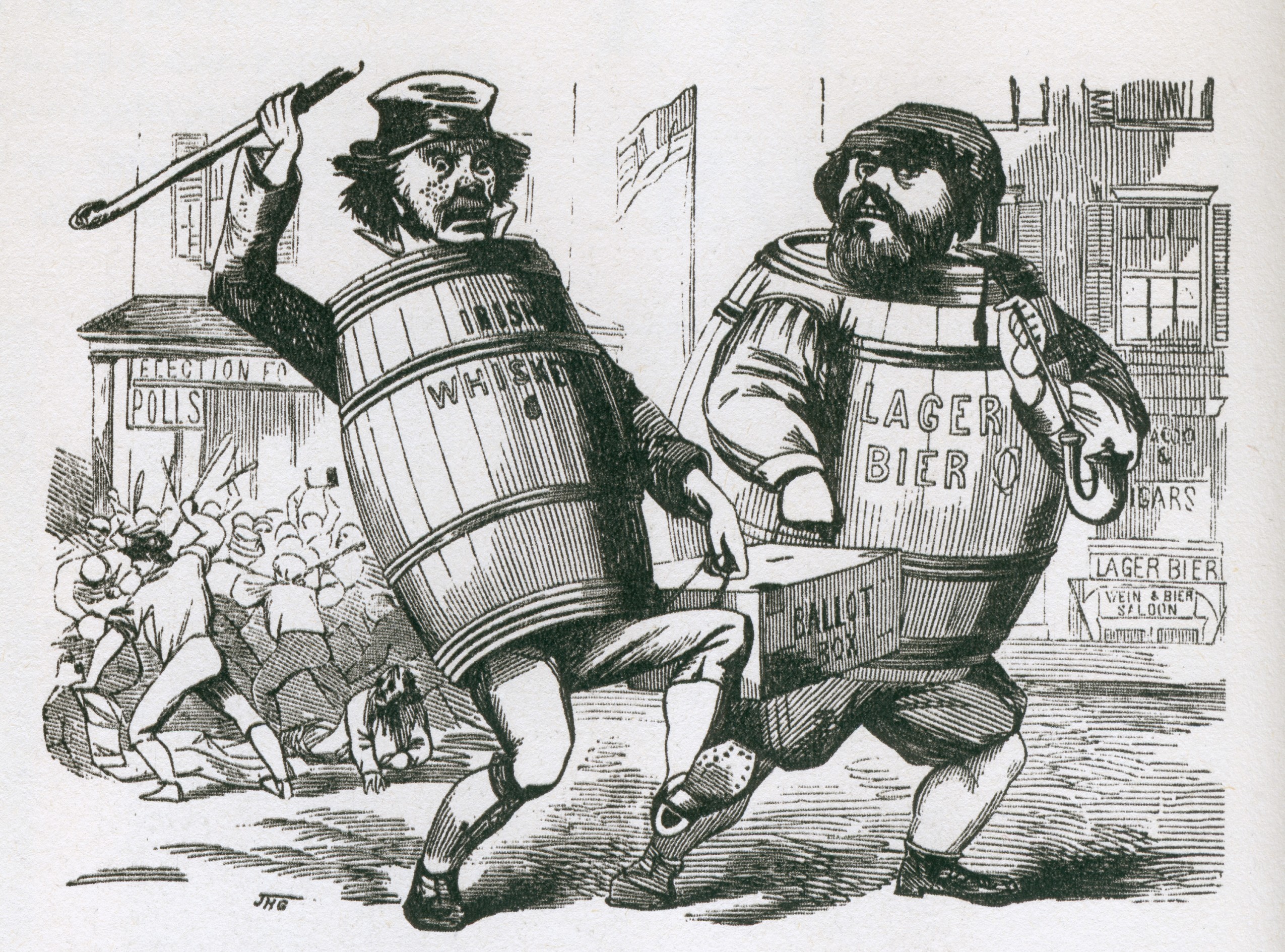
The Antebellum Era was an Age of Reform marked by progressive movements and deep divisions. While some reformers sought radical change, others pursued restrictive reform, limiting who belonged in American society. As Irish and German Catholics arrived in the late 1840s, Protestants feared their presence would undermine “American” values. The American Party was born from these fears and is interchangeably called the “Know Nothing Party,” originating because members often said “I know nothing” when questioned on their political affiliation. Built on growing xenophobia, the American Party Platform of 1856 pushed restrictive reform. It aimed to block immigrants and Catholics from rights and political influence. This reflected the Age of Reform’s exclusionary policies.
Restrictive Reform and the Know-Nothing Platform
The American Party Platform of 1856 was drafted by the Know-Nothing Party to attract native-born Protestant voters and gain power. Consequently, the party pursued restrictive reform, fearing that Irish and German Catholic immigrants threatened true American values. Furthermore, historian Dale Baum notes their appeal in Massachusetts, where anti-Catholic sentiment helped them win 397 of 400 legislative seats. (Baum 959).
By limiting immigrant voting, office access, and naturalization (Anbinder), the Know-Nothing platform aimed to preserve a “pure” American identity. This stance highlights the party’s narrow view of citizenship and backlash against immigration-driven social changes during the Age of Reform.
Origins of the Know-Nothing Party
The Know-Nothing platform arose in response to Irish Catholic immigrants fleeing the Great Famine and poverty. Historian Christopher Klein details the brutal “Coffin Ship” conditions and prejudice they faced in Boston and New York (Klein).
Immigrant Challenges and Public Perception
Many immigrants arrived impoverished, and native-born Americans, mostly Protestants, saw them as unskilled, culturally alien, and loyal to the Pope. This anti-immigrant sentiment combined with national division over slavery. While the Know-Nothings initially gained support, their restrictive reform stance was soon overshadowed by the slavery debate. Baum notes their focus on preserving Protestant “American” values could not sustain influence as anti-slavery movements grew, shifting supporters to the Republican Party (Baum 964). This period reflects a society in turmoil, with tensions over religion, ethnicity, and regional loyalty defining much of American political life.
Policies Targeting Immigrants
Importantly, the platform shows how restrictive reform and nativist anxieties shaped political movements during the Age of Reform. As a result, Americans increasingly viewed Irish and Catholic immigrants as threats to national identity.
Similarly, Abraham Lincoln, writing to Joshua Speed in 1855, criticized the Know-Nothings’ stance as hypocritical in claiming liberty and equality.
He wrote, “When the Know-Nothings get control, it will read ‘all men are created equal, except negroes, and foreigners, and Catholics.’” (Lincoln). Lincoln’s criticism helps reveal the platform’s limitations; while the document exhibits the nativist impulse to define an “authentic and acceptable” American identity, it omits the perspectives of immigrants, whose diverse opinions are the staple thread in weaving together the multicultural fabric of American society.
Decline of Nativist Influence
Baum also observes that the Know-Nothings’ influence itself was limited, and although the platform had radical and reformative aspirations, as slavery issues took center stage, their restrictive reform policies were left behind as many voters shifted to the anti-slavery Republican Party (Baum 974). The platform’s narrow, restrictive focus and its failure to engage with broader widespread social issues during the Age of Reform reveal its limitations in responding to the complex needs of a rapidly changing nation. The American Party Platform of 1856 is a window into the nativist anxieties of the Age of Reform, illustrating how some reformers sought not to expand rights but to restrict them.
Historical Significance of Restrictive Reform
While the platform’s anti-immigrant stance found brief footing, Lincoln’s critique underscores its inherent contradictions with American ideals of equality, revealing how its underlying restrictive reform approach was fated for failure. Meanwhile, as anti-slavery movements intensified, the Know-Nothing Party’s influence gradually waned. Nevertheless, the platform remains a key reminder of the tension between exclusionary and inclusive visions of American identity today.
Sources and Further Reading
Lincoln, Abraham. “Letter to Joshua F. Speed.” National Park Service, 24 Aug. 1855. https://www.nps.gov/liho/learn/historyculture/knownothingparty.htm
Anbinder, Tyler. Nativism and Slavery: The Northern Know Nothings and the Politics of the 1850s. New York, NY, 1992; online edn, Oxford Academic, 31 Oct. 2023. https://doi.org/10.1093/oso/9780195072334.001.0001
“American Party Platform (1856).” Dictionary of American History, Encyclopedia.com, 14 Oct. 2024. https://www.encyclopedia.com/history/dictionaries-thesauruses-pictures-and-press-releases/american-party-platform-1856
Baum, Dale. “Know-Nothingism and the Republican Majority in Massachusetts: The Political Realignment of the 1850s.” The Journal of American History, vol. 64, no. 4, 1978, pp. 959–986. https://doi.org/10.2307/1890732
Klein, Christopher. “When the Americans Despised the Irish.” CUNY Academic Commons, Mar. 2022. https://historynyc.commons.gc.cuny.edu/wp-content/blogs.dir/15692/files/2022/03/When-America-Despised-the-Irish.pdf
Leave a Reply